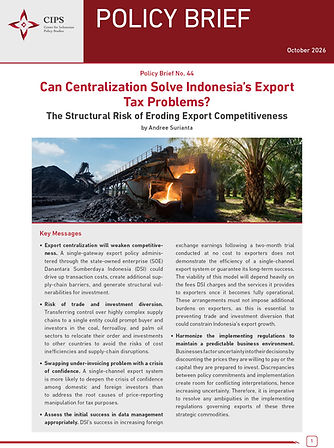
Can Centralization Solve Indonesia’s Export Tax Problems? The Structural Risk of Eroding Export Competitiveness
Authors

Andree Surianta

Export centralization will weaken competitive ness. A single-gateway export policy adminis tered through the state-owned enterprise (SOE) Danantara Sumberdaya Indonesia (DSI) could drive up transaction costs, create additional sup ply-chain barriers, and generate structural vul nerabilities for investment.
Risk of trade and investment diversion. Transferring control over highly complex supply chains to a single entity could prompt buyer and investors in the coal, ferroalloy, and palm oil sectors to relocate their order and investments to other countries to avoid the risks of cost inefficiencies and supply-chain disruptions.
Swapping under-invoicing problem with a crisis of confidence. A single-channel export system is more likely to deepen the crisis of confidence among domestic and foreign investors than to address the root causes of price-reporting manipulation for tax purposes.
Assess the initial success in data management appropriately. DSI’s success in increasing foreign exchange earnings following a two-month trial conducted at no cost to exporters does not demonstrate the efficiency of a single-channel export system or guarantee its long-term success. The viability of this model will depend heavily on the fees DSI charges and the services it provides to exporters once it becomes fully operational. These arrangements must not impose additional burdens on exporters, as this is essential to preventing trade and investment diversion that could constrain Indonesia’s export growth.
Harmonize the implementing regulations to maintain a predictable business environment. Businesses factor uncertainty into their decisions by discounting the prices they are willing to pay or the capital they are prepared to invest. Discrepancies between policy commitments and implementation create room for conflicting interpretations, hence increasing uncertainty. Therefore, it is imperative to resolve any ambiguities in the implementing regulations governing exports of these three strategic commodities.