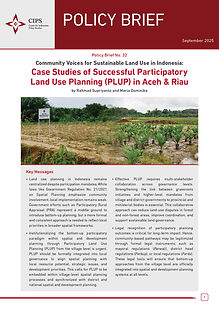
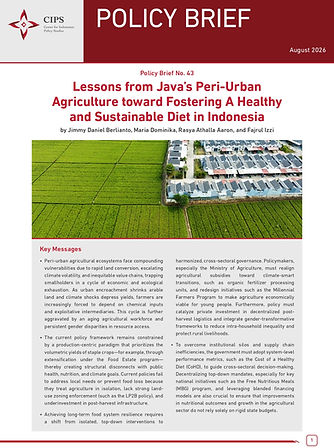
Lessons from Java’s Peri-Urban Agriculture toward Fostering A Healthy and Sustainable Diet in Indonesia
Authors

Jimmy Daniel Berlianto

Maria Dominika
Peri-urban agricultural ecosystems face compounding vulnerabilities due to rapid land conversion, escalating climate volatility, and inequitable value chains, trapping smallholders in a cycle of economic and ecological exhaustion. As urban encroachment shrinks arable land and climate shocks depress yields, farmers are increasingly forced to depend on chemical inputs and exploitative intermediaries. This cycle is further aggravated by an aging agricultural workforce and persistent gender disparities in resource access.
The current policy framework remains constrained by a production-centric paradigm that prioritizes the volumetric yields of staple crops—for example, through extensification under the Food Estate program— thereby creating structural disconnects with public health, nutrition, and climate goals. Current policies fail
to address local needs or prevent food loss because they treat agriculture in isolation, lack strong land-use
zoning enforcement (such as the LP2B policy), and underinvestment in post-harvest infrastructure.
Achieving long-term food system resilience requires a shift from isolated, top-down interventions to harmonized, cross-sectoral governance. Policymakers, especially the Ministry of Agriculture, must realign
agricultural subsidies toward climate-smart transitions, such as organic fertilizer processing units, and redesign initiatives such as the Millennial Farmers Program to make agriculture economically viable for young people. Furthermore, policy must catalyze private investment in decentralized postharvest logistics and integrate gender-transformative frameworks to reduce intra-household inequality and protect rural livelihoods.
To overcome institutional silos and supply chain inefficiencies, the government must adopt system-level
performance metrics, such as the Cost of a Healthy Diet (CoHD), to guide cross-sectoral decision-making. Decentralizing top-down mandates, especially for key national initiatives such as the Free Nutritious Meals (MBG) program, and leveraging blended financing models are also crucial to ensure that improvements in nutritional outcomes and growth in the agricultural sector do not rely solely on rigid state budgets.

Rasya Athalla Aaron