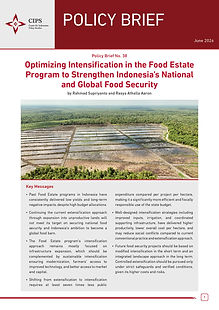
Optimizing Intensification in the Food Estate Program to Strengthen Indonesia’s National and Global Food Security

Authors

Rahmad Supriyanto

Rasya Athalla Aaron
Past Food Estate programs in Indonesia have consistently delivered low yields and long-term negative impacts, despite high budget allocations.
Continuing the current extensification approach through expansion into unproductive lands will not meet its target on securing national food security and Indonesia’s ambition to become a global food barn.
The Food Estate program’s intensification approach remains mostly focused on infrastructure expansion, which should be complemented by sustainable intensification ensuring modernization, farmers’ access to improved technology, and better access to market and capital.
Shifting from extensification to intensification requires at least seven times less public expenditure compared per project per hectare, making it a significantly more efficient and fiscally responsible use of the state budget.
Well-designed intensification strategies including improved inputs, irrigation, and coordinated supporting infrastructure, have delivered higher productivity, lower overall cost per hectare, and may reduce social conflicts compared to current conventional practice and extensification approach.
Future food security projects should be based on modified intensification in the short term and an integrated landscape approach in the long term. Controlled extensification should be pursued only under strict safeguards and verified conditions, given its higher costs and risks