top of page

Enhancing Indonesia’s Competitiveness in the Sustainable Trade and Investment Landscape

Pink Flowers_edited.jpg

Penulis

Girl with Backpack

Andree Surianta

Girl with Backpack

Deasy Pane

In export competitiveness, conventional concerns like price and quality are no longer all that matters. Buyers increasingly prefer products made in more environmentally sustainable ways. Trading partners are responding to this reality with policy, such as the European Union’s Carbon Border Adjustment Mechanism (CBAM) and China’s green product codes, and multinational companies are greening their supply chains.

Responding to this shift is key to competitiveness in global markets. This paper finds Indonesia is falling behind its Association of Southeast Asian Nations (ASEAN) peers. First, Indonesia has the highest trade-energy emissions (TEE) in the region, driven by an export basket dominated by aluminum and iron/steel processing, which are fuel-intensive industries. Indonesia is also a major ASEAN exporter of fertilizer, cement, and ceramics, sectors that rely heavily on natural gas as an energy source. Second, Indonesia has the lowest carbon competitiveness score among ASEAN countries (58.8). Its renewable share is not far below Malaysia and Thailand, but it combines the highest grid carbon intensity with the largest export dependence on CBAM-exposed sectors and the weakest export diversification. Singapore leads the ASEAN nations with the highest score at 84.9, followed by Vietnam at 79.2, Thailand at 77.5, Malaysia at 73.3, and the Philippines at 72.0

Reforms are needed to close this gap, and international economic agreements can serve as a catalyst. Indonesia has signed several comprehensive economic partnership agreements (CEPAs) and bilateral agreements that include provisions to advance sustainable trade, investment, and the transfer of green technology. Indonesia is also in the process of accession to the OECD, where sustainability is an important best practice. However, these external catalysts are undercut by domestic policy. First, monopolistic energy practices by state-owned enterprises slow the low carbon industrial transition. Second, carbon pricing remains underdeveloped: Law 7/2021 and Presidential Regulation 110/2025 provide a legal foundation, but coverage and enforcement are limited. Third, incentives to attract energy transition investment are insufficient: financial incentives are scarce and licensing and quota systems for low-carbon energy are inadequate, further weakening investor confidence. Fourth, the regulatory landscape is fragmented: overlapping mandates across ministries create uncertainty over implementation, information, and reporting, leaving businesses unsure where to seek guidance. Indonesia’s monitoring, reporting, and verification (MRV) system is also underdeveloped, limiting the credibility of industrial carbon accounting.

To strengthen Indonesia’s competitiveness, this paper recommends three actions. First, use trade agreements to accelerate low-carbon technology cooperation and investment facilitation. Second, adopt an open energy market to secure export competitiveness by removing PT Perusahaan Listrik Negara (PLN)’s monopoly bottlenecks, lifting renewable installation quotas, and phasing out fossil fuel subsidies. Third, develop a single, robust industrial carbon measurement mechanism for Indonesian exporters.

Girl with Backpack

Felippa Amanta

Publikasi Lainnya

Pink Flowers_edited.jpg

Enhancing Indonesia’s Competitiveness in the Sustainable Trade and Investment Landscape

Pink Flowers_edited.jpg

The Effect of Regional Institutional Quality on Entrepreneurial Flourishing in Decentralized Indonesia

Pink Flowers_edited.jpg

Pelajaran dari Pertanian Periurban di Jawa untuk Mendorong Konsumsi Pangan yang Sehat dan Berkelanjutan di Indonesia

Pink Flowers_edited.jpg

Kesenjangan Iklim-Gizi: Mewujudkan Sistem Pangan Indonesia yang Sehat dan Berkelanjutan

Pink Flowers_edited.jpg

Lessons from Java’s Peri-Urban Agriculture toward Fostering A Healthy and Sustainable Diet in Indonesia

Pink Flowers_edited.jpg

The Climate-Nutrition Disconnect: Championing Indonesia’s Healthy and Sustainable Food System

Pink Flowers_edited.jpg

Protecting Children in the Digital Space: Strengthening PP TUNAS through a Shared Responsibility Approach

Pink Flowers_edited.jpg

Menjembatani Fragmentasi Kebijakan: Menyelaraskan Sistem Pangan Indonesia untuk Perbaikan Gizi

Pink Flowers_edited.jpg

Meningkatkan Produktivitas: Investasi ke Pekebun Swadaya sebagai Motor Percepatan Pertumbuhan Ekonomi

Pink Flowers_edited.jpg

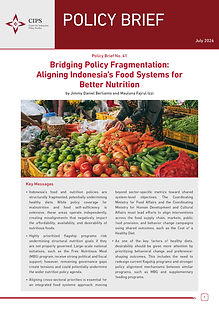
Bridging Policy Fragmentation: Aligning Indonesia’s Food Systems for Better Nutrition

Pink Flowers_edited.jpg

Unlocking Productivity: Investing in Oil Palm Smallholders to Achieve Rapid Growth

Pink Flowers_edited.jpg

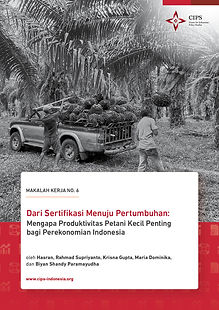
Dari Sertifikasi Menuju Pertumbuhan: Mengapa Produktivitas Petani Kecil Penting bagi Perekonomian Indonesia

Pink Flowers_edited.jpg

From Certification to Growth: Why Smallholder Productivity Matters for Indonesia’s Economy

Pink Flowers_edited.jpg

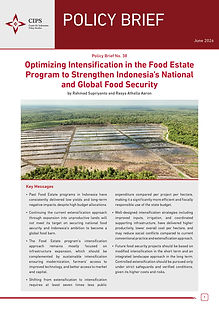
Optimizing Intensification in the Food Estate Program to Strengthen Indonesia’s National and Global Food Security

Pink Flowers_edited.jpg

Casting the Right Policy Net: Should Indonesia Use Quotas to Manage Its Fisheries?

Pink Flowers_edited.jpg

Tata Kelola yang Lebih Baik untuk Program Makan Bergizi Gratis (MBG) Indonesia

Pink Flowers_edited.jpg

Menavigasi Masa Depan Dunia Kerja: Pendekatan Kebijakan untuk Pekerjaan Gig di Indonesia

Pink Flowers_edited.jpg

Better Governance for Indonesia’s Free Nutritious Meal Program (MBG)

Pink Flowers_edited.jpg

Improving Female Students’ Motivation in STEM through School-based Intervention

Pink Flowers_edited.jpg

Navigating the Future of Work: Policy Approaches for Gig Work in Indonesia

Pink Flowers_edited.jpg

Melindungi Anak di Ruang Digital: Memperkuat PP TUNAS melalui Pendekatan Tanggung Jawab Bersama

Pink Flowers_edited.jpg

Digitalisasi Rantai Nilai Pangan: Memperkuat Posisi dan Kesejahteraan Petani

Pink Flowers_edited.jpg

Digitalizing the Food Value Chain: Strengthening Farmers’ Position and Welfare

Pink Flowers_edited.jpg

Dampak Sistem Neraca Komoditas terhadap Birokrasi Perdagangan dan Harga Pangan di Indonesia

Pink Flowers_edited.jpg

The Impact of the Commodity Balance System on Trade Bureaucracy and Food Price in Indonesia

Pink Flowers_edited.jpg

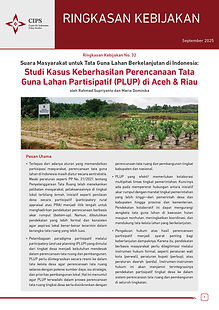
Suara Masyarakat untuk Tata Guna Lahan Berkelanjutan di Indonesia: Studi Kasus Keberhasilan Perencanaan Tata Guna Lahan Partisipatif (PLUP) di Aceh & Riau

Pink Flowers_edited.jpg

Community Voices for Sustainable Land Use in Indonesia: Case Studies of Successful Participatory Land Use Planning (PLUP) in Aceh & Riau

Pink Flowers_edited.jpg

Indonesia's Accession to OECD Understanding the Economic Implications

Pink Flowers_edited.jpg

Bayang-Bayang Penyensoran: Perkembangan Kebijakan Moderasi Konten Indonesia

Pink Flowers_edited.jpg

Shadows of Censorship: Indonesia’s Content Moderation Policy Development

Pink Flowers_edited.jpg

Mengoptimalkan Pembelajaran yang Berpusat pada Siswa untuk Pemulihan Pembelajaran yang Efektif

Pink Flowers_edited.jpg

Mengoptimalkan Potensi Ekonomi Indonesia melalui Aksesi OECD

Pink Flowers_edited.jpg

Menafsir Ulang Food Estate Indonesia: Jejak, Dinamika, dan Masa Depan Ketahanan Pangan Nasional

Pink Flowers_edited.jpg

Harnessing Student-Centered Learning for Effective Learning Recovery

Pink Flowers_edited.jpg

Unlocking Indonesia’s Economic Potential Through OECD Accession

Pink Flowers_edited.jpg

Indonesia’s Food Estate in Context: Bridging Past, Present and Future for National Food Security

Pink Flowers_edited.jpg

Shared Responsibility: Redefining Stakeholders’ Roles in Digital Era

Pink Flowers_edited.jpg

Menargetkan Efisiensi: Meninjau Kembali Reformasi Subsidi Pupuk Indonesia

Pink Flowers_edited.jpg

Targeting Efficiency: Reviewing Indonesia’s Fertilizer Subsidy Reform

Pink Flowers_edited.jpg

Tanggung Jawab Bersama: Menata Ulang Peran Para Pemangku Kepentingan di Era Digital

  • Youtube CIPS
  • Twitter CIPS
  • Instagram CIPS
  • LinkedIn CIPS
  • Email CIPS
bottom of page